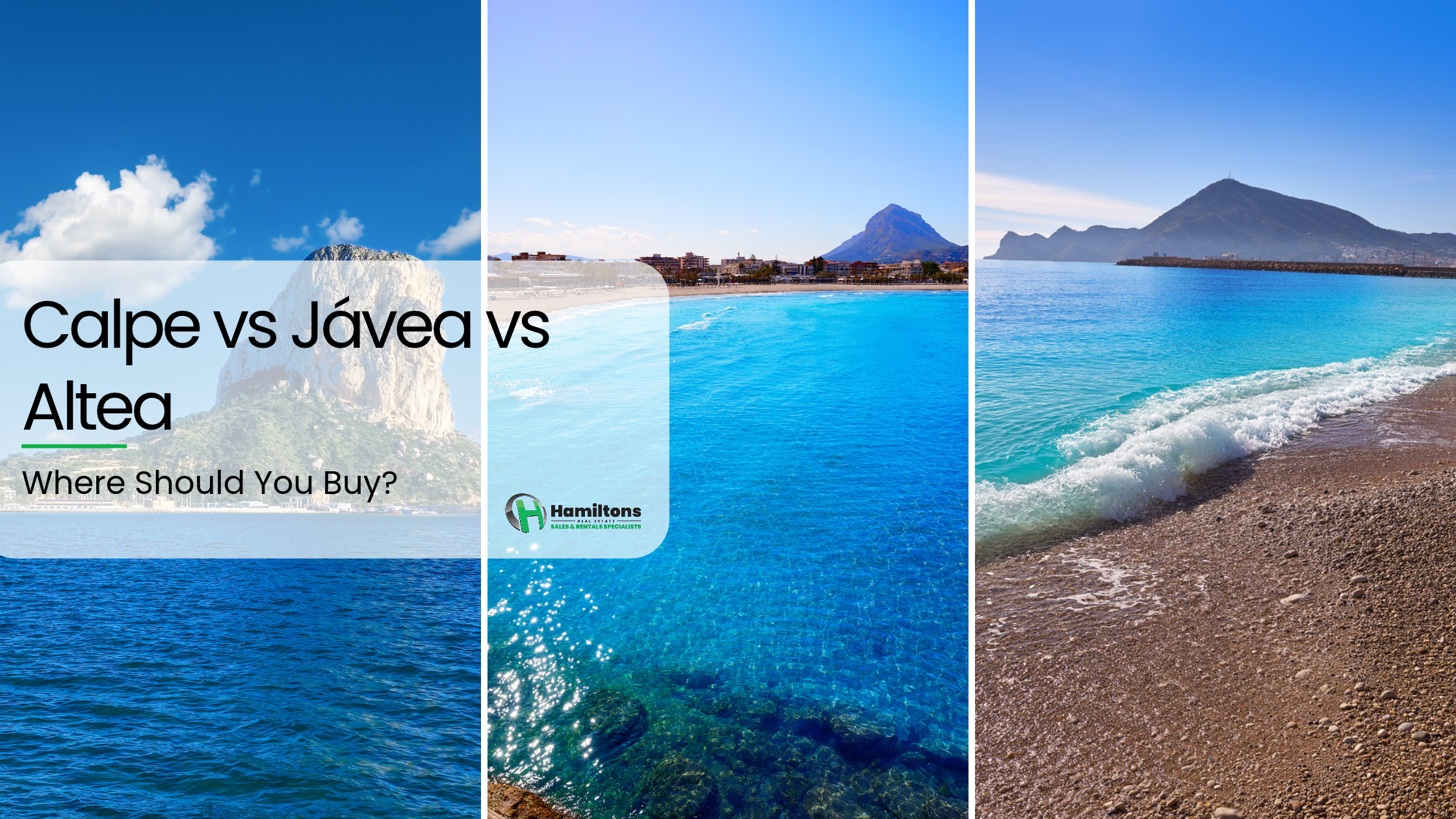
It happens quite often. A buyer starts by saying, “We’re looking for a property in Calpe.”
Then they describe what they actually want.
They would like to walk to restaurants. They want somewhere that still feels alive in winter. A sea view would be wonderful. They like the idea of a villa, although an apartment near the beach might be easier. They want somewhere with character, but also plenty going on.
At that point, the conversation can get interesting.
Because Calpe may indeed be exactly right. But drive north to Jávea or south to Altea and you can find many of those same ingredients arranged in completely different ways.
That is one of the useful things about buying on the Costa Blanca North. You don't necessarily have to change your wish list. Sometimes you simply need to see how three different towns interpret it.
Calpe is probably the hardest of the three to describe in a single sentence.
The Peñón de Ifach dominates the skyline, but concentrate only on the famous rock and two long beaches and you miss much of what makes the town interesting.
There is the Arenal-Bol and its promenade on one side, La Fossa on the other, the working fishing port, Las Salinas with flamingos appearing in the middle of town, the Old Town and a large year-round community getting on with ordinary life around all of it.
Spend enough time here and the Peñón starts to become less of a landmark and more of a compass.
Calpe is also larger and more spread out than some buyers expect. That creates variety.
Close to the Arenal-Bol, La Fossa and the centre, apartments put the beach, restaurants, shops and town life close at hand. Some of the older apartments can also surprise buyers with their proportions; newer isn't automatically the only interesting option.
Move away from the centre and another Calpe appears. Maryvilla, Gran Sol, Empedrola and La Cometa bring villas, pools, terraces, outdoor space and different outlooks into the search.
This is one reason Calpe works for such a broad mix of people. It isn't asking every buyer to live the same version of Costa Blanca life.
Drive north and Jávea feels different.
One of the first things we explain to buyers is that talking about “Jávea” as though it were one compact place isn't particularly helpful.
The Old Town, Port and Arenal form three distinct centres, and each has its own atmosphere.
The Old Town is the traditional heart of Jávea, with a stronger sense of Spanish town life and history.
Head towards the sea and the Port changes the mood. It remains a working port but mixes Spanish and international life, the waterfront and everyday amenities.
Then there is the Arenal, with its sandy beach, restaurants and much more social feel. Families with teenagers often understand the appeal of this part of Jávea very quickly: there is somewhere to go and something happening without every outing having to become a family expedition.
Beyond those three centres, the property search spreads out again.
Areas including Piver, Tosalet, Cap Martí, Cansalades, Villes del Vent, Balcón al Mar, El Rafalet, La Lluca and the Montgó offer different combinations of villas, residential surroundings, space and setting.
That makes Jávea particularly interesting for buyers who don't want their choice reduced to “town or beach”.
There is much more in between.
Altea makes perhaps the strongest first impression of the three.
Our local team has a simple description for it: “a postcard picture on the top of a hill overlooking the Mediterranean.”
It is difficult to argue with that when you see the whitewashed Old Town sitting above the Mediterranean.
But, as with Calpe and Jávea, that familiar image is only one part of the place.
Come down from the cobbled streets of the Old Town and you have Altea town itself, then the beachfront and promenade, port and marina. Move in the other direction, into the surrounding hills, and the property market changes towards detached villas, larger homes, panoramic views, privacy and luxury urbanisations.
Altea therefore has a very different rhythm depending on where you buy.
Around the promenade, everyday life can involve walking for coffee, restaurants, shops and the seafront. It can work particularly well for people who enjoy having amenities close at hand and don't want every small journey to involve getting into the car.
Up in Altea Hills, the emphasis changes considerably. Here buyers are generally looking towards privacy, elevated positions, substantial villas and panoramic sea views.
Sierra de Altea offers another variation on that hillside lifestyle, while Altea la Vella has a smaller village atmosphere and is particularly appreciated by people looking for tranquillity while remaining connected to everyday amenities.
Then there is Mascarat, adding another coastal setting to the Altea property search.
Altea isn't simply the Old Town. In property terms, it stretches from cobbled streets and townhouses to beachfront apartments, marina living and substantial villas looking out across the Mediterranean.
This is where comparing the three becomes more useful than simply deciding which one has the nicest beach.
In Calpe, the sea feels woven into a larger, busier town. You have two major beach areas, promenades, the fishing port and the Peñón, but also shops, businesses, schools, services and residential neighbourhoods extending away from the waterfront.
In Jávea, the coast is more divided. The Port and Arenal give you two quite different ways of living beside the sea, while many villa areas sit away from those main centres.
In Altea, the relationship is different again. The promenade and beachfront can put the Mediterranean into your daily routine, while the elevated areas turn the sea into the view you come home to.
That difference sounds subtle until you start viewing properties.
Then it becomes quite significant.
All three can offer it, but not in quite the same way.
Calpe has a particularly strong year-round practical side. It has a substantial local Spanish population alongside its international residents, and the town continues working outside the main holiday season.
You notice it in ordinary things: businesses open, children going to school, people shopping, the fishing boats returning to the port and cyclists appearing in greater numbers during the cooler months.
Jávea divides that everyday life between its different centres. Someone who loves the Old Town may have a very different routine from someone based near the Arenal, while the Port creates another option again.
Altea town has its own practical, local character, while the promenade adds the cafés, restaurants, sea and social side of living there.
They are all year-round places, but their daily rhythms aren't interchangeable.
This is another interesting comparison because all three have an older side, yet none feels quite like the others.
Calpe's Old Town provides a contrast to the open promenades and apartment-lined coastline. It is one of the details that often gets overlooked when people know Calpe mainly from photographs of the Peñón.
Jávea's Old Town feels more like a distinct centre in its own right — one of the three principal parts of the town rather than an interesting corner of it.
Altea takes the idea furthest. Its elevated Old Town, whitewashed buildings, traditional townhouses, cobbled streets and cultural atmosphere are fundamental to the identity of the town. Our Altea team finds it particularly appealing to buyers who value architecture, culture and individuality.
So a buyer can say “I'd like somewhere with a traditional Spanish side” and still have three rather different possibilities to explore.
Search online for villas for sale in Calpe, Jávea and Altea and it can initially look as though you are comparing variations of the same thing: pool, terrace, Mediterranean garden, perhaps a sea view.
On the ground, the settings make those homes feel very different.
In Calpe, established residential areas such as Gran Sol, Empedrola, La Cometa and Maryvilla give you alternatives to the apartments and denser development nearer the centre and beaches.
Jávea has a broad collection of established villa areas spreading around the town and towards the Montgó and coast. Tosalet doesn't feel like the Arenal; Montgó doesn't feel like the Port. That variety is an important part of the Jávea search.
In Altea, heading uphill can become part of the property story itself. Altea Hills and Sierra de Altea bring elevated villas, views, privacy and space much more strongly into the picture.
This is why property photographs alone can only take a buyer so far.
The house might tick the boxes. The setting determines what living there actually feels like.
Again, the three towns offer quite different choices.
Calpe has a large apartment market around the centre, Arenal-Bol and La Fossa. One detail our team often notices is that some older apartments can offer more generous internal space than buyers expect when they have been concentrating entirely on new developments.
Jávea apartment buyers will often find themselves comparing the lifestyle around the Arenal with the Port and other parts of town. Here, location within Jávea can change the experience considerably.
Altea brings the beachfront, town, port and marina into the apartment search. Around the promenade, the appeal is the combination of sea and everyday amenities, while the port and marina provide another coastal setting with apartments and communal properties.
So even the simple request “two-bedroom apartment near the sea” can take the search in three quite different directions.
This may be the biggest difference that doesn't show up particularly well on a property portal.
Calpe feels like a larger coastal town with several recognisable districts and residential areas gathered around a very obvious landmark.
Jávea feels more dispersed, with Old Town, Port and Arenal acting almost like separate anchors and villa areas filling the landscape around them.
Altea has a pronounced vertical element: waterfront and town below, historic Old Town above, then hillside residential areas climbing further into elevated positions.
That geography influences everything from the view from a terrace to how naturally you use the town.
And sometimes this is where a buyer changes direction.
They may arrive convinced they want a villa and discover that an apartment near the promenade gives them far more of the lifestyle they were imagining.
Or they may start close to town and realise that what has really caught their attention is the space and outlook available further into the residential areas.
That's not getting the original search wrong.
It's what viewings are for.
There isn't a useful one-word answer, and we wouldn't try to manufacture one.
Choose Calpe and you can have a lively, practical year-round coastal town with two major beach areas, a working fishing port, Old Town, Las Salinas, apartments close to the action and villa neighbourhoods spreading away from the centre.
Choose Jávea and you get a town with three particularly distinct personalities — Old Town, Port and Arenal — surrounded by a wide choice of established residential and villa areas.
Choose Altea and the character changes again: a striking historic Old Town, seafront promenade, town and marina below, with Altea la Vella, Sierra de Altea and Altea Hills taking you towards quieter, elevated and increasingly luxurious surroundings.
The interesting part is that you don't always know which one will click from a laptop.
Hamiltons has local teams working across these different parts of the Costa Blanca, and that's useful when a search begins in one town but the brief points somewhere else. Rather than trying to make every buyer fit the location they first typed into Google, we can compare what those locations actually offer.
Sometimes Calpe is exactly where the search finishes.
Sometimes Calpe is where the search starts.
And that is one of the advantages of having Jávea and Altea just along the coast.